
Fertility Preservation for Women Diagnosed with Cancer

Starting the Conversation
Fertility Preservation for Women Diagnosed with Cancer
Introduction
appstore

Many women of childbearing age who have been diagnosed with cancer think that preserving their fertility is important and want information about their options. However,

  • Patients may not feel comfortable bringing up fertility issues.
  • Patients may not be aware of their options for preserving fertility.
  • Patients may be focused on their cancer diagnosis and unable to think about fertility or the possibility of having a future family.

Women may later regret not considering fertility issues prior to starting cancer treatment.

Understanding that there are fertility preservation options available and referring at-risk patients to specialists can improve patients’ emotional outlook and future quality of life.

Even women with a poor prognosis may want to consider fertility preservation.

Fertility Preservation - Where Does It Fit?
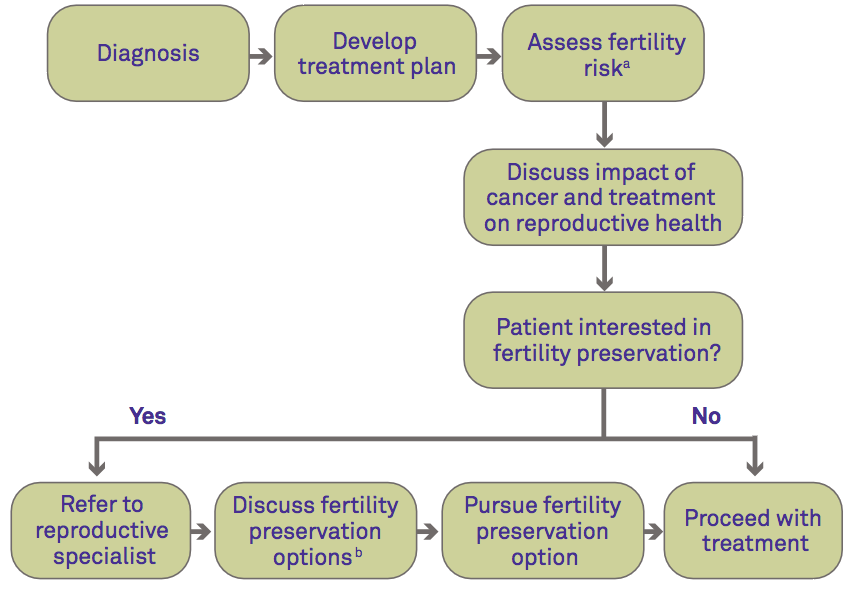
a) See table below
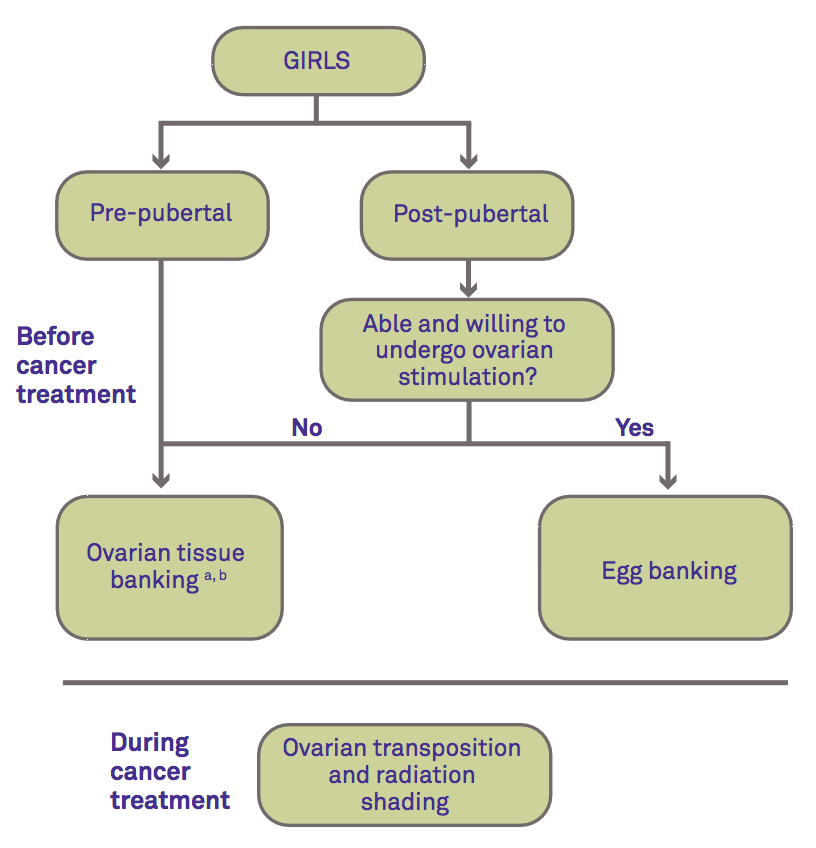
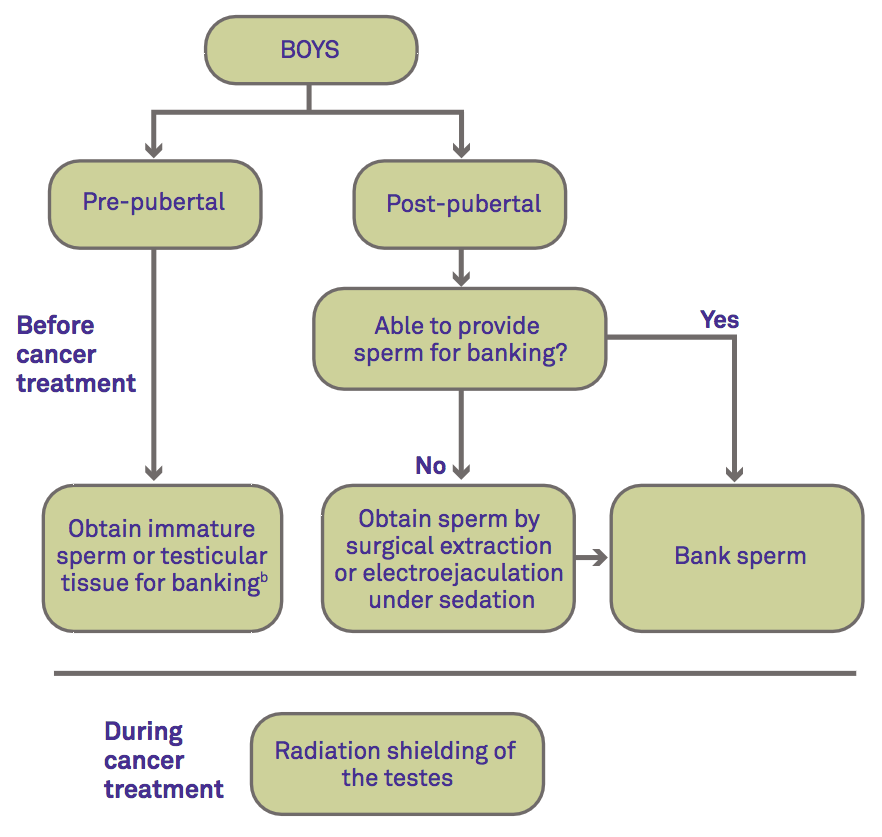
b) See figure below

Starting the Conversation

You may not be comfortable speaking with your patients about the risk of infertility related to their cancer or planned cancer treatment. These key points can help start the conversation:

  • Cancer and cancer treatment may affect your fertility.
  • Based on your treatment plan, your risk of infertility is [high, moderate, low].
  • Have you ever thought about having a child/more children? Although it may not be on your mind now, many patients find themselves wishing they had thought about this when they had the chance.
  • You have options to try to preserve your fertility before you begin cancer treatment.
  • Cancer, cancer treatment, or fertility preservation will not harm your future children. (Although you may pass on the gene for some hereditary cancers, we may be able to test for those).
  • You may retain or regain your fertility, or not make use of any fertility preservation methods you may have used.  However, it is important to explore your options now to avoid regret in the future.
  • Fertility preservation and pregnancy do not appear to increase the risk of cancer recurrence; however, pregnancy may be considered high risk.
  • I can refer you to a fertility preservation specialist if you would like to discuss your options further.
  • Remember that there are other ways to build a family after cancer if we are unable to preserve your fertility now. Talking with a specialist can help you explore other options that might be right for you.
Options for Fertility Preservation

The following table gives a brief description of options available to women who wish to preserve their fertility.

The American Society of Clinical Oncology and American Society for Reproductive Medicine recommend that, when possible, at-risk patients be referred to a fertility preservation specialist prior to starting cancer treatment.

Several resources are listed on the back cover that can help you and your patients locate a fertility preservation specialist.


Fertility preservation options for women diagnosed with cancer

OptionDefinitionTimingTime RequirementOther Considerations
Embryo BankingHarvesting eggs,
IVF, and freezing of
embryos for later
implantation
Before or after
treatment
10–14 days from
menses; outpatient
surgical procedure
Need partner or
donor sperm
Egg Banking
(Experimental)
Harvesting and
freezing of
unfertilized eggs for
IVF and implantation
after cancer
treatment
Before or after
treatment
10–14 days from
menses; outpatient
surgical procedure
May be attractive to
single women or
those opposed to
embryo creation
Ovarian Tissue
Banking
(Experimental)
Freezing of ovarian
tissue and reimplantation
of tissue or in vitro
maturation of follicles
and fertilization of eggs
after cancer treatment
Before or after
treatment
Outpatient surgical
procedure
Tissue not suitable for
transplant if high risk
of ovarian metastases;
no live births to date
from in vitro
maturation
Radiation
Shielding
Use of shielding
to reduce scatter
radiation to the
ovaries
During treatmentIn conjunction
with radiation
treatments
Does not protect
against effects of
chemotherapy
Ovarian
Transposition
Surgical
repositioning of
ovaries away from
the radiation field
Before treatmentOutpatient
procedure or
in conjunction
with gynecologic
cancer surgery
 
Radical
Trachelectomy
Surgical removal
of the cervix with
preservation of
the uterus
During treatmentInpatient surgical
procedure
Limited to early
stage cervical
cancer
Ovarian
Suppression
(Experimental)
GnRH analogs or
antagonists used
to suppress
ovaries
During treatmentIn conjunction with
chemotherapy
Does not protect
from radiation
effects
Donor
Embryos
Embryos
donated by
a couple
After treatmentVaries;
is done in
conjunction
with IVF
Donor embryo
available
through
IVF clinics
or private
agencies
Donor EggsEggs donated
by a woman
After
treatment
Varies;
is done in
conjunction
with IVF
Patient can
choose donor
based on
various
characteristics
Gestational
Surrogacy
Woman
carries a
pregnancy
for another
woman or
couple
After
treatment
Varies; time
is required to
find surrogate
and implant
embryos
Legal status
varies by
state
AdoptionProcess
that creates
a legal
parent–child
relationship
After
treatment
Varies
depending
on type of
adoption
After puberty;
medical
history may
be a factor

Table adapted from 2006 American Society of Clinical Oncology recommendations on fertility preservation in cancer patients; and Fertile Hope. Cancer and Fertility: Fast Facts for Reproductive Professionals.
IVF=in vitro fertilization • GnRH=gonadotropin-releasing hormone

Cancer Therapy and the Risk of Infertility

For women of childbearing age, the first step to fertility preservation is assessing the risk of developing infertility secondary to their planned cancer treatment.

The following table classifies various cancer therapies and regimens based on their known infertility risk in women (defined as permanent amenorrhea).

Fertile Hope also provides an online risk calculator.

For patients who wish to try for a pregnancy, it is important to take into account the patient’s age when planning their cancer treatment.  Patients who are over the age of 35 may have reduced fertility preservation options.


Infertility risk associated with specific cancer treatments and regimens

High Risk
  • Whole abdominal or pelvic radiation doses >6 Gy in adult women
  • Whole abdominal or pelvic radiation doses >10 Gy in postpubertal girls
  • Total body irradiation (TBI)
  • Cranial/brain irradiation >40 Gy
  • CMF, CEF, or CAF x 6 cycles in women >40 years
  • Cyclophosphamide 5 g/m2 in women >40 years
  • Cyclophosphamide 7.5 g/m2 in girls <20 years
  • Alkylating chemotherapy (e.g., cyclophosphamide, busulfan, melaphan) conditioning for transplant
  • Any alkylating agent (e.g., cyclophosphamide, ifosfamide, busulfan, BCNU [carmustine], CCNU [lomustine]) + TBI or pelvic radiation
  • Protocols containing procarbazine: MOPP, MVPP, COPP, ChlVPP, ChlVPP/EVA, BEACOPP, MOPP/ABVD, COPP/
    ABVD
Intermediate Risk
  • Whole abdomina or pelvic radiation 5 to <10 Gy in postpubertal girls
  • Spinal radiation doses >25 Gy CMF, CEF, or CAF x 6 cycles in women 30–39 years
  • AC in women >40 years
Low Risk
  • AC in women 30–39 years
  • CMF, CEF, or CAF x 6 cycles in women <30 years
  • Nonalkylating chemotherapy: ABVD, CHOP, COP
  • AC
No Risk
  • Radioactive iodine
  • MF
  • Vincristine
Unknown Risk
  • Paclitaxel, docetaxel (taxanes used in AC protocols)
  • Oxaliplatin
  • Irinotecan
  • Bevacizumab
  • Cetuximab
  • Trastuzumab
  • Erlotinib
  • Imatinib

Table adapted from the 2006 American Society of Clinical Oncology recommendations on fertility preservation in cancer patients; Fertile Hope. Cancer and Fertility: Fast Facts for Reproductive Professionals; and Meirow D, et al. Clin Obstet Gynecol. 2010;53:727-739.

CMF=cyclophosphamide/methotrexate/fluorouracil • CEF=cyclophosphamide/epirubicin/fluorouracill • CAF=cyclophosphamide/adriamycin (doxorubicin)/fluorouracill • MOPP=mechlorethamine/oncovin (vincristine)/procarbazine/prednisonel • MVPP=mechlorethamine/vinblastine/procarbazine/prednisolonel • COPP=cyclophosphamide/oncovin/procarbazine/prednisonel • ChlVPP=chlorambucil/vinblastine/procarbazine/prednisolonel • EVA=etoposide/vinblastine/adriamycinl • BEACOPP=bleomycin/etoposide/adriamycin/cyclophosphamide/oncovin/procarbazine/prednisonel • ABVD=adriamycin/bleomycin/vinblastine/dacarbazinel • AC=adriamycin/cyclophosphamidel • CHOP= cyclophosphamide/hydroxydaunomycin/oncovin/prednisonel • COP=cyclophosphamide/oncovin/prednisonel • MF=methotrexate/5-fluorouracil

Resources

For more information about infertility risk, fertility preservation options for women diagnosed with cancer, and how to locate and refer your patients to a fertility preservation specialist:

The Oncofertility Consortium® is a national, interdisciplinary initiative designed to explore the reproductive future of cancer survivors.

The Hormone Foundation®, the public education affiliate of The Endocrine Society®, serves as a resource for the public by promoting the prevention, treatment, and cure of hormone-related conditions through outreach and education.

The development of this pocket guide was supported by educational grants from Merck and EMD Serono.

© 2011 The Oncofertility Consortium® and The Hormone Foundation®

SaveMyFertility.org